How Much Milk Does a Baby Need After Starting Solids?
September 24, 2026
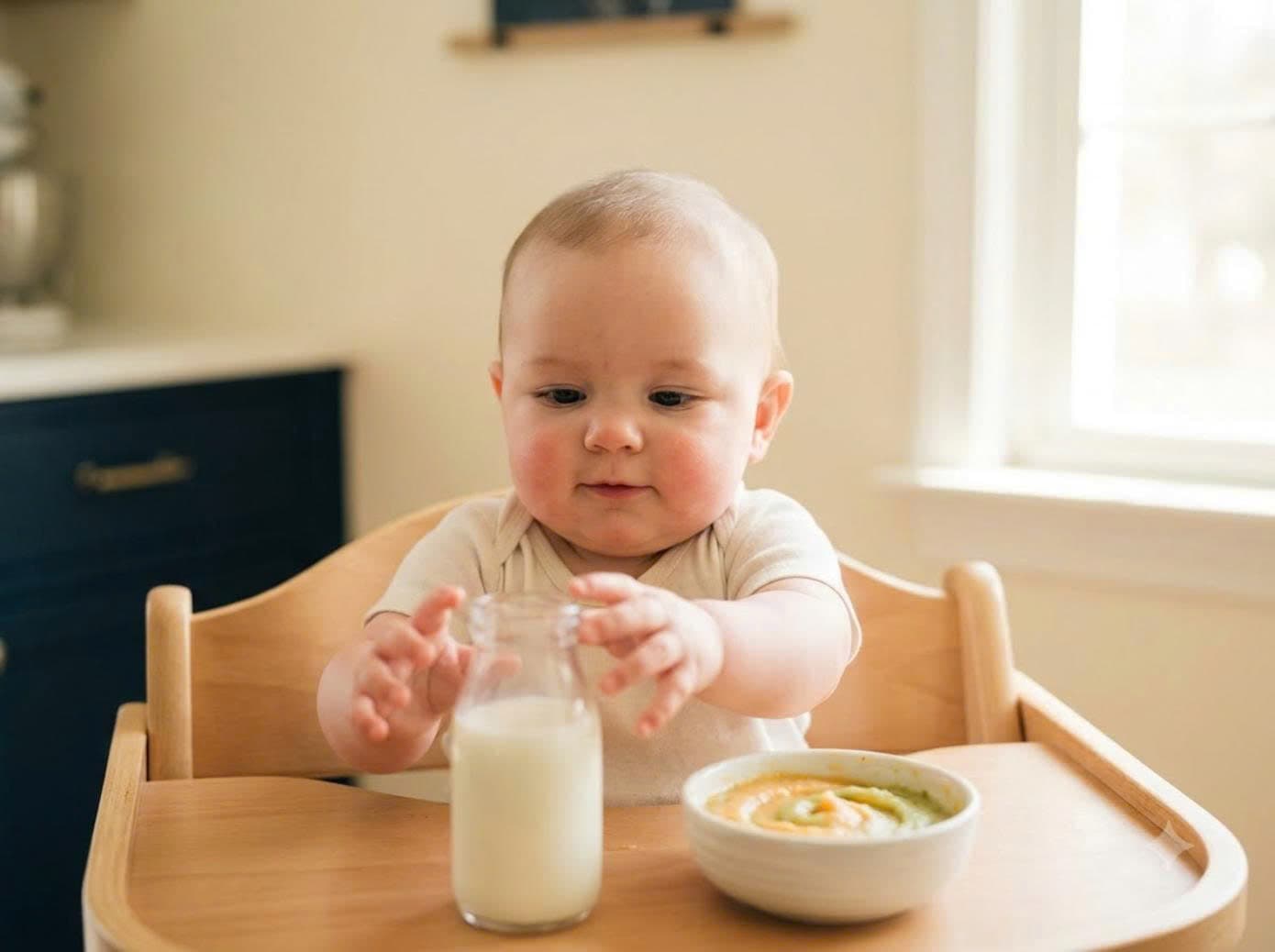
About the same as before solids, for the first few months. At six months a formula fed baby takes 6 to 8 ounces at each of 4 or 5 feedings a day, and a breastfed baby keeps nursing on cue, according to the American Academy of Pediatrics' guide to formula amounts. Milk eases down from about nine months and stays your baby's main food until twelve months.
The short version: solids are added to milk, they do not replace it. Keep milk feeds where they were, offer food in a calm slot around them, and let the drop in milk come slowly, led by your baby.
Do babies drink less milk when they start solids?
Not at first. The first weeks of solids are practice. A spoonful of mashed pear at lunch is about taste, texture and the new job of moving food around a mouth, and it is far too small to replace a feed.
Most babies take about the same milk for the first months of solids. The American Academy of Pediatrics says that at first your baby still gets most of their nutrition from breast milk, formula or both, in its guide to starting solid foods. The CDC's formula feeding guidance puts the change plainly: as your baby gradually eats more solid foods, they gradually need less infant formula.
So a small dip at the feed closest to a meal is normal. A big drop in the first month of solids is not the usual pattern, and it is covered in the section on when to call below.
How long after solids should I give milk?
There is no set wait. Neither the AAP nor the CDC gives a number of minutes, and milk straight after food is fine.
The AAP's guide to starting solid foods describes one sitting: a little breast milk or formula first, then small half spoonfuls of food, then more milk to finish. After that, let your baby's behavior set the gap.
Still hungry after food. Give milk now. There is nothing to wait for.
Frantic and crying at the spoon. Too hungry to learn. Give a little milk first, then try the food.
Full and playing with the food. Too full to be curious. Move the milk feed further from the meal next time.
Breastfed and less interested in nursing. The CDC suggests you breastfeed before you offer other foods.
How much formula does a five month old need on solids?
The same as without solids. A few spoonfuls do not replace a bottle, so the bottles stay where they were.
The AAP gives no separate figure for five months. Its answer on how much formula a baby needs gives you three guides instead.
By weight. On average, about 2.5 ounces a day for every pound of body weight. A twelve pound baby works out at about 30 ounces a day.
By the bottle. Feeds tend to grow by about 1 ounce a month, then level off at about 7 to 8 ounces each.
The ceiling. A baby does not need more than 32 ounces of formula in a day.
Five months is early for food. The CDC says a child can begin eating solid foods at about six months, and that food before 4 months is not recommended. If your baby has started before six months, ask your pediatrician to check the plan and how the feeds fit around it.
How much milk does a baby need at six months?
The same as just before solids started.
Formula fed. The AAP describes a six month old taking 6 to 8 ounces (180 to 240 mL) at each of 4 or 5 feedings in 24 hours, and usually no more than about 32 ounces (960 mL) a day.
Breastfed. There is no ounce figure, because you cannot see the ounces. Keep nursing on cue, day and night, as you did before food arrived.
Combination fed. Keep the pattern you had. Add food around it, not in place of a feed.
What changes at six months is the space around the feeds. You find one calm slot for food, often a while after a milk feed, when your baby is awake, not starving and not tired.
If you are still deciding when to start, read the signs a baby is ready for solids.
How much milk should a seven month old drink with solids?
About the same as at six months, with food building around it. The AAP gives no separate figure for seven months, so its six month figure is the one to use: 6 to 8 ounces at each of 4 or 5 feedings, and no more than about 32 ounces in a day. A breastfed baby keeps nursing on cue.
What moves at seven months is the food. The World Health Organization's fact sheet on infant and young child feeding describes 2 to 3 meals a day from six to eight months. One feed may get a little shorter while the others stay about the same. For what to put on the plate, see which first foods suit each age.
How much breast milk does a baby need after starting solids?
As much as your baby asks for. A breastfed baby's intake is set by feeding on cue, and that does not stop when food starts.
Breast milk stays the main source of nutrition. The CDC's guidance on how much and how often to breastfeed says breast milk is the most important source of nutrition even after solids begin.
It carries a large share of energy all year. The WHO fact sheet says breast milk can provide half or more of a child's energy needs between six and twelve months.
Nurse before food if interest dips. The CDC suggests that if your baby seems less interested in breastfeeding after solids start, you breastfeed before you offer other foods.
You know it is enough the same way you knew before solids: steady growth at checkups, regular wet diapers and a baby who is content between feeds.
For the very first days of feeding, see breastfeeding in the first days, and what is normal.
How much milk does a nine month old need?
Neither the AAP's formula guide nor the CDC gives a separate ounce figure for nine months. What the guidance does say:
Milk is still the main food. It stays that way until twelve months, with food doing more of the work each month.
Five or six feeding times a day is typical. The CDC's formula feeding guidance says most babies from six to twelve months need infant formula or solid foods about 5 to 6 times a day, so by nine months some of those times are meals rather than bottles.
The ceiling has not moved. About 32 ounces of formula a day is still the usual upper amount from the AAP. More milk than that can leave little room for food.
From about nine months, the drop you see is real and gradual. A daytime feed gets shorter, then gets skipped. A bottle is left half full after lunch. Night feeds may thin out on their own. None of that is a problem while your baby is growing well and still takes milk regularly across the day.
How much breast milk at nine months with solids?
There is no ounce figure, so nurse on cue. The CDC's breastfeeding guidance gives no amount for this age and says to breastfeed when you notice signs of hunger. The WHO's figure still holds at nine months: breast milk can provide half or more of a child's energy needs up to twelve months.
Some feeds will get shorter as meals grow to 3 to 4 a day, the WHO's guide from nine months. That is the expected pattern, not a falling supply.
If you pump and want a number to aim for, ask your pediatrician or a lactation consultant, who can work from your baby's weight and growth. The formula amounts above are for formula.
The month by month balance, six to twelve months
Each stage gives the milk, the food, and the sign to watch for.
About six months. Milk: the main food, breastfed on cue, or formula at 6 to 8 ounces 4 or 5 times a day. Food: first tastes, one calm slot a day. Notice: your baby opens their mouth for the spoon and swallows rather than pushing food out.
Seven to eight months. Milk: still the main food, offered before meals if interest dips. Food: building toward 2 to 3 meals a day, which is the WHO's guide for six to eight months. Notice: one feed may get a little shorter, and the others stay about the same.
Nine to ten months. Milk: still a large share of the day, with some daytime feeds shortening or dropping. Food: 3 to 4 meals a day, more texture, finger foods. Notice: your baby eats with interest and still takes milk several times a day.
Eleven to twelve months. Milk: fewer, steadier feeds, often around waking and bedtime. Food: family meals, cut to size, plus snacks if hungry. Notice: growth stays on track at checkups, and milk has eased down, not stopped.
Read the notice line before the milk line. If those signs hold, the balance is working, whatever the exact ounces are.

How do you tell whether the balance is right for your baby?
You watch your baby rather than the bottle.
Steady growth at checkups. A baby following their own curve is getting enough, whatever the split between milk and food.
Regular wet diapers through the day. A clear drop is worth noticing.
Content between feeds and meals. Not grazing all day, not frantic at every feed.
Interest in food without losing interest in milk. Both should be happening at the same time in the second half of the year.
Following cues. The WHO calls this responsive feeding: noticing signs of hunger and fullness, and responding to them. A baby who turns away, closes their mouth or pushes the spoon off is telling you they are done.
If you are still deciding how to offer food in the first place, our guide to baby led weaning versus purees compares the two side by side.
When is a drop in milk worth a call to the pediatrician?
Call your pediatrician if you see any of these:
Your baby suddenly refuses most milk feeds and is not yet eating much food.
Wet diapers become clearly fewer.
Your baby seems unusually sleepy, floppy or hard to wake for feeds.
Weight has slipped at a checkup, or you are worried it has.
Your baby refuses both milk and food for more than a day.
A gradual, uneven drop in milk over months, with a baby who is growing and eating, is the normal pattern. If the problem is the food rather than the milk, see what to do when a baby is refusing solids. You are allowed to call for reassurance too.
FAQ
How much milk should a baby drink after starting solids?
About the same as before solids for the first few months. A six month old on formula takes 6 to 8 ounces at each of 4 or 5 feedings, according to the AAP, and a breastfed baby keeps nursing on cue. Milk then eases down slowly as meals grow.
Should solids come before or after a milk feed?
In the early months, after, or at a separate time. Milk is still the main food, and a baby who is full on food may take less milk than they need. Toward twelve months, as meals become family meals, many parents move milk to after food.
Is it normal for a baby to refuse milk once solids start?
A little less interest at one feed is common, especially the feed closest to a meal. Refusing most milk feeds in the first months of solids is not the usual pattern and is worth a call to your pediatrician, especially with fewer wet diapers.
Can a baby drink too much milk after starting solids?
Yes. A formula fed baby usually needs no more than about 32 ounces a day, according to the AAP. A baby who fills up on milk can have little appetite left for food, which matters most for iron rich foods in the second half of the year.
Does a baby need vitamin D as formula drops?
It is worth asking. The CDC's formula guidance says a baby getting less than 32 ounces of formula a day needs extra vitamin D, and that line gets crossed as meals grow. Ask your pediatrician what to give and how much.
When does cow's milk come in?
At twelve months, not before. The CDC's page on cow's milk and milk alternatives explains that cow's milk given earlier can put a baby at risk of intestinal bleeding, carries too many proteins and minerals for a baby's kidneys, and lacks the nutrients a baby needs.
Does gagging on food mean my baby should go back to milk only?
No. Gagging is a normal part of learning to eat and is not the same as choking. Our guide to gagging versus choking in babies shows how to tell them apart.
Starting solids, with a plan for the first weeks
The first month of solids is where most of the questions land. Our free guide, Starting solids: the first 4 weeks, is a short PDF built for exactly that stretch. Get the free Starting solids guide from the library, and find more on feeding through the first year on the HelianWell blog.